

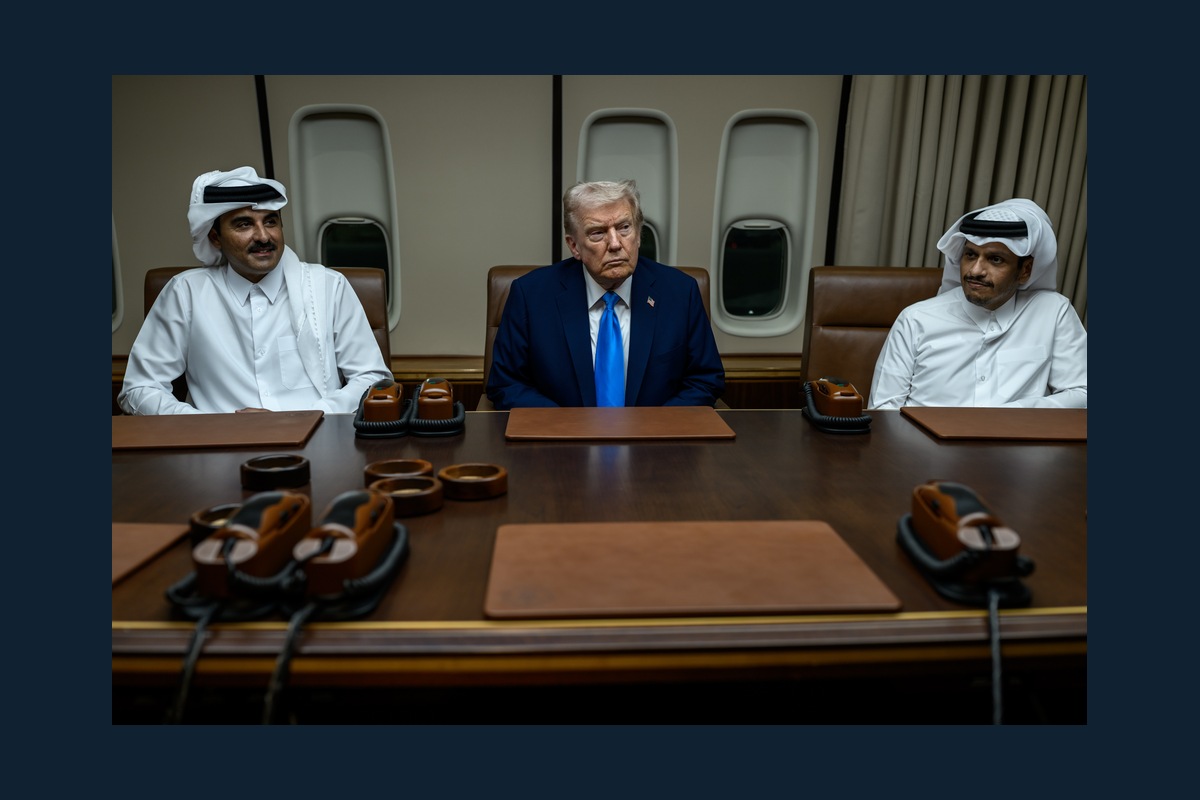
President Trump hosts Qatar’s prime minister, the key U.S.–Iran go-between, in a closed-door Oval Office meeting Monday. The pitch, per Axios: more time for diplomacy and a two-day sequence to lift the blockade and reopen the Strait of Hormuz.

Why it matters
After the midterms, many expected Trump to restart the war. Instead the chief mediator is in the building — while explosions are still being reported off Iran’s coast and oil prices hang on every word.
Driving the news
Sheikh Mohammed bin Abdulrahman Al Thani meets Vice President JD Vance first, then Trump. Axios reports Vance has spoken with him almost daily for two weeks.
The draft, according to regional sources cited by Axios:
- Day one: the U.S. lifts its naval blockade and releases some frozen Iranian funds; Iran formally invites IAEA inspectors to bombed nuclear sites.
- Day two: Hormuz reopens, followed by nuclear talks on Iran’s highly enriched uranium.
The IAEA says Iran holds 440.9 kg of uranium enriched to 60%, per Al Jazeera.
The other side
Tehran lists seven demands, including sanctions relief, frozen assets, a smaller U.S. military footprint, recognition of an Iran–Oman shipping route and an end to war “on all fronts,” Al Jazeera reports; Reuters adds reparations. Foreign Minister Abbas Araghchi on X: “American voters have made their choice. Time for the White House to make its own.”
What Washington says
Trump to CNN: “It depends on whether or not they sign a very strong agreement. The answer is, highly unlikely it’s going to be necessary.” He also cited three carriers “fully locked and loaded” and “38 bridges… that we can knock down in literally one hour.” On “60 Minutes”: “I’m not looking to. I don’t think there’s any reason to.”
Rubio: “I wouldn’t say we’re on the verge of a breakthrough.” Iran’s demands are “outrageous and ridiculous and really not realistic.”
Meanwhile, at sea
A Hormozgan deputy governor told Iranian state media the U.S. struck Qeshm Island Sunday night, with no damage to vital infrastructure (via Iran International). We found no U.S. comment as of this morning. Reuters could not confirm Iran’s claims of tankers hitting mines. Houthis claimed an attack on Saudi Aramco offices in Riyadh; Saudi officials reported debris damage and no injuries.

Your wallet
Brent fell 0.75% to $97.57 by 10:11 GMT Monday; WTI slipped to $90.45 (CNBC/Reuters). Brent lost 16% last week, its steepest weekly drop since the pandemic began. Saxo’s Ole Hansen: oil is trading “on hopes of a US-Iran peace deal rather than concrete signs of progress.”
Our view
We think Monday matters more than any post. Qatar is bringing a sequence, not a slogan — and sequencing is exactly what has broken every past deal: whoever moves first takes the risk. “Highly unlikely” plus three carriers on standby isn’t a contradiction; it’s the method. If the strait opens, gas gets cheaper. If not, last week’s drop can reverse in an evening.
FAQ
What’s the two-day plan? Day one: blockade lifted, some funds freed, IAEA invited. Day two: Hormuz reopens, nuclear talks resume (per Axios).
Will the U.S. strike again? Trump calls it “highly unlikely” with a strong deal but hasn’t ruled it out.
Will gas get cheaper? Oil is falling on hope. Without a reopened strait, the slide could reverse.
Read also
- U.S. disables the Huda as the Hormuz blockade goes to sea
- Strikes on Qeshm and Qatar’s Hormuz plan
- Task Force Iron Gate targets Iran’s land borders and the Caspian
Sergey Danilov


Leave a Reply