



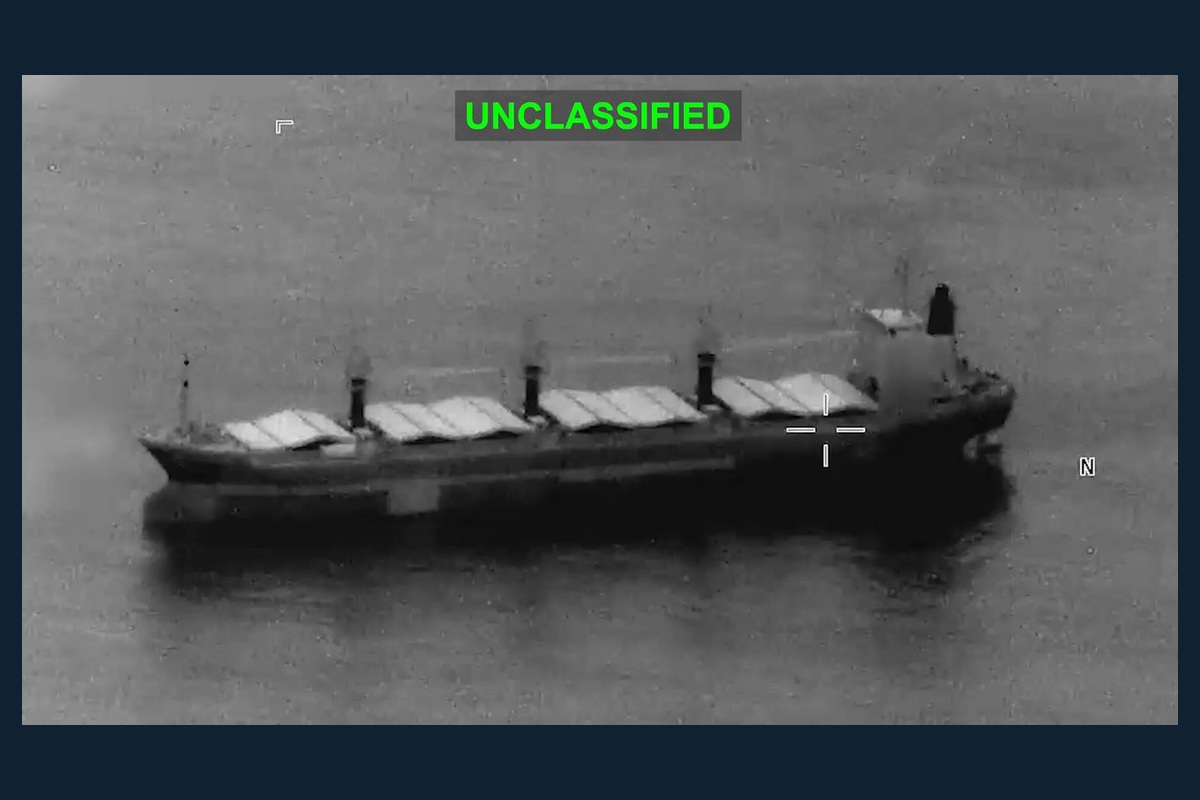
The U.S. Navy’s Iran blockade is no longer just a statement. On Saturday, CENTCOM said American forces disabled a cargo ship in the Gulf of Oman. Hours later, Iran said two oil tankers were on fire near the Strait of Hormuz. Those are not the same event — and they do not have the same level of proof.


Why it matters
A large share of the world’s oil still has to pass this narrow waterway. When ships are shot at, mined, or abandoned, the story shows up later at American gas pumps. Sunday markets are closed; we are not inventing a weekend price spike. The live question is whether traffic through Hormuz still looks normal.
Driving the news
- On Nov. 7, U.S. Central Command said its forces disabled a commercial vessel in the Gulf of Oman after the civilian crew “ignored repeated warnings and attempted to violate the naval blockade against Iran multiple times.”
- A U.S. military aircraft fired precision munitions at the stern of the St. Kitts-flagged M/V Huda after directing the crew to abandon targeted spaces. CENTCOM said the ship had visited an Iranian port and tried to leave regional waters.
- Enforcement since July, according to the same release: 147 commercial vessels were redirected after they complied; five merchant ships were disabled because they refused. CENTCOM also said it had previously destroyed another 10 Iranian commercial oil tankers described as part of the IRGC’s shadow network.
- All mariners near Iranian coastal waters were told to heed U.S. blockade warnings.
- CENTCOM posted official video of the operation. We have not verified start and end timecodes, so the clip should be treated as B-roll, not as a timed soundbite.
The Iranian claim — still unverified
Late Saturday, the IRGC Navy said two oil tankers were burning after striking naval mines in and near the Strait of Hormuz. It said the ships had switched off navigation and positioning systems and tried an unauthorized route: one hit east of the strait, the other inside it. The vessels were not identified.
Tasnim, citing the IRGC Navy, said both ships “struck mines and exploded” and were “engulfed in intense flames.” Other vessels were warned they would hit mines if they cooperated with U.S. forces, defied Iranian rules in the strait, or entered prohibited areas. The statement also told mariners not to heed the “fantasies” of the CENTCOM commander.
No independent confirmation from international maritime authorities was available in our Sunday-morning check. This remains an Iranian claim, not a proven fact. A Marine Insight item about a U.S. denial refers to a different July episode, not to this weekend; we found no named U.S. official denial of the Nov. 7–8 tanker claim and therefore do not report one.
Separately, Gulf News reported that the UAE National Guard rescued 22 crew members of Arab nationalities from a burning cargo ship in the Gulf of Oman. All were stable after first aid. The official readout did not name the ship. Do not identify that vessel as M/V Huda.
Between the lines
Saturday’s announcement of Task Force Iron Gate — a plan to squeeze Iran’s land and Caspian routes — is already on our site. Today’s story is different: the existing naval blockade is now producing visible incidents at sea. Al Jazeera, writing Sunday, noted that Qatari-mediated talks continue and that President Trump has said Tehran still wants a deal. Diplomacy on shore and a precision strike on a cargo ship’s stern are happening in the same week.
What’s next
Watch three things: whether M/V Huda is identified in independent shipping data; whether the two unnamed tankers appear in maritime warnings under real names; and whether Qatar’s mediation produces anything more concrete than words. Anything short of that is still a claim.
Our view
We think the honest way to read this weekend is to keep the files separate. Huda is a named U.S. account, with a flag, a method, and an official photograph. The two burning tankers are, so far, a statement from Tehran without names or outside confirmation. The UAE rescue is a third scene in the same waters. Mixing them into one explosion makes a neater headline and a worse report.
FAQ
What happened to M/V Huda? CENTCOM says a U.S. aircraft disabled the St. Kitts-flagged cargo ship with a precision strike on the stern after repeated blockade violations in the Gulf of Oman.
Did two tankers hit mines? That is what the IRGC Navy says. The ships were not named, and we found no independent maritime confirmation.
Was the UAE rescue the Huda crew? The UAE did not name the ship. There is no basis to say it was Huda.
Read also
- Task Force Iron Gate and Iran’s land and Caspian routes
- US strikes on Iran’s Qeshm Island and Qatar’s Hormuz plan
- Gas, Inflation and Credit: Why Relief Arrives Slowly
Sergey Danilov



Leave a Reply